How Do You Read Restricted Quantifier Notation
In logic, a quantifier is an operator that specifies how many individuals in the domain of discourse satisfy an open formula. For instance, the universal quantifier in the kickoff order formula expresses that everything in the domain satisfies the property denoted by . On the other hand, the existential quantifier in the formula expresses that there is something in the domain which satisfies that belongings. A formula where a quantifier takes widest telescopic is called a quantified formula. A quantified formula must contain a bound variable and a subformula specifying a belongings of the referent of that variable.


Every formula in classical logic can be rewritten as a logically equivalent quantified formula in prenex normal course, where every quantifier takes the widest scope.
The mostly ordinarily used quantifiers are and . These quantifiers are standardly divers as duals and are thus interdefinable using negation. They tin can likewise be used to define more than complex quantifiers, as in the formula which expresses that zippo has the holding . Other quantifiers are only definable within 2nd order logic or higher order logics. Quantifiers take been generalized starting time with the work of Mostowski and Lindström.

First gild quantifiers guess the meanings of some tongue quantifiers such as "some" and "all". However, many tongue quantifiers can only be analyzed in terms of generalized quantifiers.
Relations to logical conjunction and disjunction [edit]
For a finite domain of soapbox D = {a1,...adue north}, the universal quantifier is equivalent to a logical conjunction of propositions with atypical terms ai (having the class Pai for monadic predicates).
The existential quantifier is equivalent to a logical disjunction of propositions having the aforementioned structure every bit before. For infinite domains of discourse, the equivalences are similar.
Infinite domain of soapbox [edit]
Consider the following argument (using dot notation for multiplication):
- 1 · 2 = ane + 1, and 2 · two = two + 2, and 3 · ii = 3 + 3, ..., and 100 · 2 = 100 + 100, and ..., etc.
This has the appearance of an infinite conjunction of propositions. From the bespeak of view of formal languages, this is immediately a problem, since syntax rules are expected to generate finite words.
The example above is fortunate in that there is a process to generate all the conjuncts. Nevertheless, if an exclamation were to be made virtually every irrational number, there would be no manner to enumerate all the conjuncts, since irrationals cannot be enumerated. A succinct, equivalent formulation which avoids these problems uses universal quantification:
- For each natural number northward, n · two = n + north.
A similar analysis applies to the disjunction,
- one is equal to v + 5, or two is equal to 5 + 5, or 3 is equal to 5 + 5, ... , or 100 is equal to 5 + 5, or ..., etc.
which can exist rephrased using existential quantification:
- For some natural number n, n is equal to 5+five.
Algebraic approaches to quantification [edit]
It is possible to devise abstract algebras whose models include formal languages with quantification, but progress has been tedious[ description needed ] and interest in such algebra has been limited. Three approaches have been devised to date:
- Relation algebra, invented by Augustus De Morgan, and developed by Charles Sanders Peirce, Ernst Schröder, Alfred Tarski, and Tarski'southward students. Relation algebra cannot represent any formula with quantifiers nested more than than three deep. Surprisingly, the models of relation algebra include the axiomatic set theory ZFC and Peano arithmetic;
- Cylindric algebra, devised by Alfred Tarski, Leon Henkin, and others;
- The polyadic algebra of Paul Halmos.
Notation [edit]
The ii near mutual quantifiers are the universal quantifier and the existential quantifier. The traditional symbol for the universal quantifier is "∀", a rotated letter "A", which stands for "for all" or "all". The corresponding symbol for the existential quantifier is "∃", a rotated letter "E", which stands for "there exists" or "exists".[1] [2]
An example of translating a quantified statement in a natural language such equally English would exist as follows. Given the statement, "Each of Peter's friends either likes to dance or likes to go to the beach (or both)", key aspects can be identified and rewritten using symbols including quantifiers. So, allow 10 be the ready of all Peter's friends, P(x) the predicate "10 likes to dance", and Q(x) the predicate "x likes to go to the embankment". And then the above sentence can be written in formal notation every bit , which is read, "for every x that is a member of 10, P applies to x or Q applies to 10".

Some other quantified expressions are synthetic equally follows,
- [3]


for a formula P. These two expressions (using the definitions to a higher place) are read every bit "in that location exists a friend of Peter who likes to trip the light fantastic toe" and "all friends of Peter like to trip the light fantastic", respectively. Variant notations include, for set X and set members ten:
- [4] [5]


All of these variations also employ to universal quantification. Other variations for the universal quantifier are
- [ commendation needed ] [vi] [seven]


Some versions of the annotation explicitly mention the range of quantification. The range of quantification must ever exist specified; for a given mathematical theory, this tin can be washed in several ways:
- Assume a stock-still domain of discourse for every quantification, as is washed in Zermelo–Fraenkel set theory,
- Fix several domains of soapbox in advance and require that each variable have a alleged domain, which is the type of that variable. This is analogous to the situation in statically typed computer programming languages, where variables have alleged types.
- Mention explicitly the range of quantification, perhaps using a symbol for the prepare of all objects in that domain (or the type of the objects in that domain).
One can use any variable as a quantified variable in identify of any other, under certain restrictions in which variable capture does not occur. Even if the note uses typed variables, variables of that type may be used.
Informally or in natural language, the "∀x" or "∃x" might appear later or in the middle of P(x). Formally, however, the phrase that introduces the dummy variable is placed in forepart.
Mathematical formulas mix symbolic expressions for quantifiers with natural language quantifiers such as,
- For every natural number x, ...
- There exists an x such that ...
- For at least i x, ....
Keywords for uniqueness quantification include:
- For exactly one natural number x, ...
- At that place is one and but one x such that ....
Further, x may exist replaced by a pronoun. For example,
- For every natural number, its product with two equals to its sum with itself.
- Some natural number is prime number.
Society of quantifiers (nesting) [edit]
The gild of quantifiers is critical to meaning, every bit is illustrated past the post-obit two propositions:
- For every natural number due north, there exists a natural number s such that south = north 2.
This is clearly true; information technology just asserts that every natural number has a square. The meaning of the assertion in which the order of quantifiers is inversed is dissimilar:
- There exists a natural number s such that for every natural number north, southward = north ii.
This is clearly false; information technology asserts that at that place is a unmarried natural number s that is the square of every natural number. This is because the syntax directs that any variable cannot be a role of subsequently introduced variables.
A less trivial example from mathematical analysis are the concepts of uniform and pointwise continuity, whose definitions differ merely by an exchange in the positions of ii quantifiers. A function f from R to R is chosen
In the former case, the particular value chosen for δ can be a function of both ε and x, the variables that precede information technology. In the latter instance, δ can exist a function only of ε (i.eastward., it has to exist chosen independent of x). For example, f(x) = x two satisfies pointwise, but non uniform continuity (its slope is unbound). In contrast, interchanging the two initial universal quantifiers in the definition of pointwise continuity does not change the meaning.
Every bit a general rule, swapping ii side by side universal quantifiers with the aforementioned telescopic (or swapping two adjacent existential quantifiers with the same scope) doesn't change the meaning/truth value of the statement (see Example here), and is a valid form of rewriting, just moving an existential quantifier in front end of an adjacent universal quantifier might lead to a quantifier shift that changes the meaning/truth value of the statement.
The maximum depth of nesting of quantifiers in a formula is chosen its "quantifier rank".
Equivalent expressions [edit]
If D is a domain of x and P(x) is a predicate dependent on object variable x, then the universal suggestion tin can exist expressed as
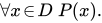
This annotation is known as restricted or relativized or bounded quantification. Equivalently ane tin can write,

The existential proposition tin can be expressed with bounded quantification as
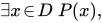
or equivalently

Together with negation, simply 1 of either the universal or existential quantifier is needed to perform both tasks:

which shows that to disprove a "for all x" proposition, one needs no more than to find an x for which the predicate is false. Similarly,

to disprove a "at that place exists an x" proposition, one needs to bear witness that the predicate is false for all x.
Range of quantification [edit]
Every quantification involves one specific variable and a domain of discourse or range of quantification of that variable. The range of quantification specifies the set of values that the variable takes. In the examples higher up, the range of quantification is the gear up of natural numbers. Specification of the range of quantification allows u.s.a. to limited the difference between, say, asserting that a predicate holds for some natural number or for some real number. Expository conventions often reserve some variable names such as "n" for natural numbers, and "x" for real numbers, although relying exclusively on naming conventions cannot piece of work in general, since ranges of variables can modify in the form of a mathematical argument.
The use of universal quantifier does non assume the range of quantification (or domain of discourse) to be non-empty; In fact, is vacuously true. Even so, the use of existential quantifier often implicitly assumes (viz. the range of quantification/domain of discourse is not-empty); In other words, is always false.
![{\displaystyle [\forall x\!\in \!\varnothing \;P(x)]\equiv \forall x\;(x\!\in \!\varnothing \to P(x))}](https://wikimedia.org/api/rest_v1/media/math/render/svg/e41d19402c708f2a3fc8881b918d4d2a4d1d8dce)

![{\displaystyle [\exists x\!\in \!\varnothing \;P(x)]\equiv \exists x\;(x\!\in \!\!\varnothing \land P(x))}](https://wikimedia.org/api/rest_v1/media/math/render/svg/7e48ba72db7395de2011f673817a6dfce4faab36)
A more natural way to restrict the domain of soapbox uses guarded quantification. For example, the guarded quantification
- For some natural number n, n is even and n is prime
means
- For some even number n, n is prime.
In some mathematical theories, a single domain of discourse fixed in advance is assumed. For instance, in Zermelo–Fraenkel set up theory, variables range over all sets. In this case, guarded quantifiers tin can be used to mimic a smaller range of quantification. Thus in the example above, to express
- For every natural number due north, n·two = n + n
in Zermelo–Fraenkel set theory, i would write
- For every north, if n belongs to Northward, then n·2 = n + n,
where Northward is the fix of all natural numbers.
Formal semantics [edit]
Mathematical semantics is the awarding of mathematics to study the meaning of expressions in a formal language. It has three elements: a mathematical specification of a course of objects via syntax, a mathematical specification of various semantic domains and the relation between the two, which is unremarkably expressed as a function from syntactic objects to semantic ones. This article merely addresses the event of how quantifier elements are interpreted. The syntax of a formula can be given by a syntax tree. A quantifier has a scope, and an occurrence of a variable x is free if it is not inside the scope of a quantification for that variable. Thus in

the occurrence of both x and y in C(y, x) is complimentary, while the occurrence of x and y in B(y, 10) is bound (i.due east. non-gratuitous).

Syntax tree of the formula , illustrating telescopic and variable capture. Bound and free variable occurrences are colored in red and green, respectively.
An estimation for first-order predicate calculus assumes equally given a domain of individuals Ten. A formula A whose complimentary variables are x 1, ..., x n is interpreted as a boolean-valued function F(5 ane, ..., 5 northward ) of n arguments, where each argument ranges over the domain Ten. Boolean-valued means that the function assumes one of the values T (interpreted as truth) or F (interpreted as falsehood). The interpretation of the formula

is the part G of due north-1 arguments such that G(v 1, ..., v northward-one) = T if and only if F(five i, ..., v north-1, westward) = T for every westward in Ten. If F(5 1, ..., v due north-1, west) = F for at least one value of w, and then G(v i, ..., v northward-one) = F. Similarly the estimation of the formula

is the role H of due north-1 arguments such that H(v 1, ..., v n-one) = T if and only if F(v 1, ..., v n-1, westward) = T for at to the lowest degree one westward and H(five 1, ..., v n-1) = F otherwise.
The semantics for uniqueness quantification requires first-order predicate calculus with equality. This means there is given a distinguished two-placed predicate "="; the semantics is too modified accordingly so that "=" is e'er interpreted as the 2-place equality relation on X. The interpretation of

and so is the function of northward-1 arguments, which is the logical and of the interpretations of

Each kind of quantification defines a corresponding closure operator on the set of formulas, by calculation, for each free variable x, a quantifier to bind 10.[eight] For example, the existential closure of the open formula northward>2 ∧ x n +y n =z northward is the airtight formula ∃due north ∃x ∃y ∃z (due north>2 ∧ 10 n +y n =z n ); the latter formula, when interpreted over the natural numbers, is known to exist false by Fermat's Last Theorem. Every bit another example, equational axioms, like x+y=y+ten, are unremarkably meant to denote their universal closure, like ∀10 ∀y (ten+y=y+x) to express commutativity.
Paucal, multal and other degree quantifiers [edit]
None of the quantifiers previously discussed apply to a quantification such as
- In that location are many integers northward < 100, such that n is divisible past 2 or 3 or 5.
I possible interpretation machinery tin be obtained as follows: Suppose that in addition to a semantic domain X, nosotros have given a probability mensurate P defined on X and cutoff numbers 0 < a ≤ b ≤ 1. If A is a formula with gratuitous variables 10 one,...,x n whose interpretation is the function F of variables v 1,...,v n then the interpretation of

is the part of 5 1,...,v n-1 which is T if and but if

and F otherwise. Similarly, the interpretation of

is the function of v 1,...,5 due north-1 which is F if and only if

and T otherwise.[ citation needed ]
Other quantifiers [edit]
A few other quantifiers take been proposed over fourth dimension. In particular, the solution quantifier,[nine] : 28 noted § (section sign) and read "those". For case,
![{\displaystyle \left[\S n\in \mathbb {N} \quad n^{2}\leq 4\right]=\{0,1,2\}}](https://wikimedia.org/api/rest_v1/media/math/render/svg/1d23c1dea39d57915c78be8af2410258de45cccc)
is read "those n in N such that n two ≤ four are in {0,1,two}." The same construct is expressible in set-builder notation as

Opposite to the other quantifiers, § yields a set rather than a formula.[ten]
Some other quantifiers sometimes used in mathematics include:
- In that location are infinitely many elements such that...
- For all but finitely many elements... (sometimes expressed every bit "for almost all elements...").
- There are uncountably many elements such that...
- For all but countably many elements...
- For all elements in a ready of positive measure out...
- For all elements except those in a set of mensurate zero...
History [edit]
Term logic, besides called Aristotelian logic, treats quantification in a manner that is closer to natural language, and too less suited to formal analysis. Term logic treated All, Some and No in the fourth century BC, in an account as well touching on the alethic modalities.
In 1827, George Bentham published his Outline of a new system of logic, with a critical examination of Dr Whately's Elements of Logic, describing the principle of the quantifier, but the volume was not widely circulated.[11]

William Hamilton claimed to accept coined the terms "quantify" and "quantification", almost likely in his Edinburgh lectures c. 1840. Augustus De Morgan confirmed this in 1847, but modern usage began with De Morgan in 1862 where he makes statements such as "Nosotros are to accept in both all and some-not-all as quantifiers".[12]
Gottlob Frege, in his 1879 Begriffsschrift, was the start to apply a quantifier to bind a variable ranging over a domain of discourse and actualization in predicates. He would universally quantify a variable (or relation) by writing the variable over a dimple in an otherwise direct line appearing in his diagrammatic formulas. Frege did non devise an explicit notation for existential quantification, instead employing his equivalent of ~∀x~, or contraposition. Frege's treatment of quantification went largely unremarked until Bertrand Russell'south 1903 Principles of Mathematics.
In piece of work that culminated in Peirce (1885), Charles Sanders Peirce and his educatee Oscar Howard Mitchell independently invented universal and existential quantifiers, and bound variables. Peirce and Mitchell wrote Πten and Σx where we now write ∀x and ∃x. Peirce'south note can be establish in the writings of Ernst Schröder, Leopold Loewenheim, Thoralf Skolem, and Polish logicians into the 1950s. Well-nigh notably, it is the notation of Kurt Gödel's landmark 1930 paper on the completeness of first-order logic, and 1931 paper on the incompleteness of Peano arithmetic.
Peirce'due south approach to quantification also influenced William Ernest Johnson and Giuseppe Peano, who invented nonetheless another notation, namely (10) for the universal quantification of x and (in 1897) ∃x for the existential quantification of 10. Hence for decades, the approved annotation in philosophy and mathematical logic was (ten)P to express "all individuals in the domain of discourse have the property P," and "(∃ten)P" for "there exists at least one individual in the domain of soapbox having the holding P." Peano, who was much amend known than Peirce, in issue diffused the latter'due south thinking throughout Europe. Peano's notation was adopted past the Principia Mathematica of Whitehead and Russell, Quine, and Alonzo Church building. In 1935, Gentzen introduced the ∀ symbol, by analogy with Peano's ∃ symbol. ∀ did non become approved until the 1960s.
Around 1895, Peirce began developing his existential graphs, whose variables can be seen as tacitly quantified. Whether the shallowest instance of a variable is fifty-fifty or odd determines whether that variable's quantification is universal or existential. (Shallowness is the opposite of depth, which is determined past the nesting of negations.) Peirce'due south graphical logic has attracted some attention in recent years past those researching heterogeneous reasoning and diagrammatic inference.
See also [edit]
- Absolute generality
- Almost all
- Branching quantifier
- Conditional quantifier
- Counting quantification
- Eventually (mathematics)
- Generalized quantifier — a higher-order holding used equally standard semantics of quantified noun phrases
- Lindström quantifier — a generalized polyadic quantifier
- Quantifier elimination
- Quantifier shift
References [edit]
- ^ "Predicates and Quantifiers". www.csm.ornl.gov . Retrieved 2020-09-04 .
- ^ "i.2 Quantifiers". www.whitman.edu . Retrieved 2020-09-04 .
- ^ 1000.R. Apt (1990). "Logic Programming". In Jan van Leeuwen (ed.). Formal Models and Semantics. Handbook of Theoretical Calculator Science. Vol. B. Elsevier. pp. 493–574. ISBN0-444-88074-7. Here: p.497
- ^ Schwichtenberg, Helmut; Wainer, Stanley S. (2009). Proofs and Computations. Cambridge: Cambridge Academy Printing. ISBN978-1-139-03190-5.
- ^ John E. Hopcroft and Jeffrey D. Ullman (1979). Introduction to Automata Theory, Languages, and Ciphering. Reading/MA: Addison-Wesley. ISBN0-201-02988-X. Hither: p.p.344
- ^ Hans Hermes (1973). Introduction to Mathematical Logic. Hochschultext (Springer-Verlag). London: Springer. ISBN3540058192. ISSN 1431-4657. Here: Def. 2.1.v
- ^ Glebskii, Yu. Five.; Kogan, D. I.; Liogon'kii, M. I.; Talanov, V. A. (1972). "Range and degree of realizability of formulas in the restricted predicate calculus". Cybernetics. 5 (ii): 142–154. doi:10.1007/bf01071084. ISSN 0011-4235.
- ^ in general, for a quantifer Q, closure makes sense only if the lodge of Q quantification does non matter, i.e. if Q x Q y p(x,y) is equivalent to Q y Q ten p(x,y). This is satisfied for Q ∈ {∀,∃}, cf. #Order of quantifiers (nesting) to a higher place.
- ^ Hehner, Eric C. R., 2004, Practical Theory of Programming, 2d edition, p. 28
- ^ Hehner (2004) uses the term "quantifier" in a very general sense, also including e.m. summation.
- ^ George Bentham, Outline of a new system of logic: with a disquisitional examination of Dr. Whately's Elements of Logic (1827); Thoemmes; Facsimile edition (1990) ISBN 1-85506-029-9
- ^ Peters, Stanley; Westerståhl, Dag (2006-04-27). Quantifiers in Language and Logic. Clarendon Printing. pp. 34–. ISBN978-0-19-929125-0.
Bibliography [edit]
- Barwise, Jon; and Etchemendy, John, 2000. Language Proof and Logic. CSLI (University of Chicago Printing) and New York: 7 Bridges Press. A gentle introduction to first-social club logic by two first-rate logicians.
- Frege, Gottlob, 1879. Begriffsschrift. Translated in Jean van Heijenoort, 1967. From Frege to Gödel: A Source Book on Mathematical Logic, 1879-1931. Harvard University Press. The starting time appearance of quantification.
- Hilbert, David; and Ackermann, Wilhelm, 1950 (1928). Principles of Mathematical Logic. Chelsea. Translation of Grundzüge der theoretischen Logik. Springer-Verlag. The 1928 first edition is the beginning time quantification was consciously employed in the now-standard fashion, namely equally binding variables ranging over some fixed domain of discourse. This is the defining aspect of first-guild logic.
- Peirce, C. Due south., 1885, "On the Algebra of Logic: A Contribution to the Philosophy of Annotation, American Journal of Mathematics, Vol. vii, pp. 180–202. Reprinted in Kloesel, N. et al., eds., 1993. Writings of C. S. Peirce, Vol. 5. Indiana University Printing. The kickoff appearance of quantification in anything like its nowadays course.
- Reichenbach, Hans, 1975 (1947). Elements of Symbolic Logic, Dover Publications. The quantifiers are discussed in chapters §xviii "Binding of variables" through §30 "Derivations from Synthetic Premises".
- Westerståhl, Dag, 2001, "Quantifiers," in Goble, Lou, ed., The Blackwell Guide to Philosophical Logic. Blackwell.
- Wiese, Heike, 2003. Numbers, linguistic communication, and the homo listen. Cambridge University Press. ISBN 0-521-83182-2.
External links [edit]
- "Quantifier", Encyclopedia of Mathematics, EMS Press, 2001 [1994]
- ""For all" and "in that location exists" topical phrases, sentences and expressions". Archived from the original on March ane, 2000. . From College of Natural Sciences, University of Hawaii at Manoa.
- Stanford Encyclopedia of Philosophy:
- Shapiro, Stewart (2000). "Classical Logic" (Covers syntax, model theory, and metatheory for first club logic in the natural deduction way.)
- Westerståhl, Dag (2005). "Generalized quantifiers"
- Peters, Stanley; Westerståhl, Dag (2002). "Quantifiers"
Source: https://en.wikipedia.org/wiki/Quantifier_(logic)
Post a Comment for "How Do You Read Restricted Quantifier Notation"