Persian Painting Woman Woman Scarf Tied Under Chin Art

Land Museum of Oriental Art
The exhibition Splendor of the Dusk: Iran of the Qajar Era, dedicated to the creative legacy of the Qajar dynasty, is open in the Moscow State Museum of Oriental Fine art until July 25th. The rulers of this dynasty came to power in Iran in the late 18th century and this era was characterized by a simultaneous interest in European cultures and the glorification of Islamic republic of iran'south own history. We asked curator Polina Korotchikova to talk nigh i of the works presented at the exhibition— a portrait of a beautiful woman that reflects the ethics and hopes of Iranians during that time.
With the ascent of the second ruler of the Qajar dynasty, Fat'h-Ali Shah, to the throne, a new type of portrait appeared: that of beautiful women. The images we see on these portraits represent an ideal woman of that time, with concubines from the Shah harem oft meant to exist the basis of this ideal. The women in these pictures are, on the 1 hand, utterly idealized, and on the other—quite existent, because their images and desirable qualities correlated with the structure of Iranian order.
This type of painting was hung in the male half of the business firm and meant as decoration. Works of various quality have been preserved—some of them are simpler and were meant to be affordable for people of moderate ways, such as provincial governors or landowners, while some were very expensive. Demand for such paintings was very high: information technology was fashionable to have at least one such portrait.
This text takes a await at i of the portraits made past an unknown Iranian painter in the 19th century: Woman at the Window.
Beauty: Cosmetics and the Body

Cosmetics and fragrances
In Qajar Iran, a cosmetic haft-rang (an expression literally translates to "seven colors") set was frequently used. The set was equanimous of vii elements: henna, basma, surma (kajal), chroma, perfume, beauty mark, and white face pigment. The latter was fabricated from ground fauna bone and animal fat. A painted or stick-on imitation beauty mark could be placed anywhere—in that location was nothing alike to the European courtly dazzler spot language in Iran.
Islamic republic of iran did not have the kind of incense and perfumes that we imagine when we think of the East. The thought that one should smell "overnice" was also not widespread. People used the simplest kind of soap—it was made from sheep fat and smelled like sheep fat. Fragrant lather was imported from Turkey. Women first used it on the eve of their wedding; before that they were not supposed to enjoy such a luxury and they smelled but like anybody else. Rose h2o was a universal peel intendance product—information technology was sprayed onto the body and used to wipe the confront. Rose h2o was a tonic, a cream, and a perfume. Furthermore, it was thought that it has antiseptic properties.
Face
A beautiful woman had to be moon-faced—with a circular face and pocket-size, pouty lips. The beauty standard for the ideal shape of eyebrows was universal: for men as well every bit women, the two eyebrows were supposed to exist joined at the bridge of the nose. If a woman did not have such eyebrows naturally, they were painted on with a dark surma-based dye, which gave the eyebrows a bluish tint. For hair and eyes, a glassy blackness or an indigo color was considered in vogue.

Tattoos
Easily and feet, including soles, fingers and toes, were covered in henna. This was also considered fashionable for both men and women. Just as in the case of eyebrows, we can speak of a sure fashion, widespread at the time—that of masculinity. Playing with masculinity and femininity was a general feature of local culture—it was good already at the time of the Safavid dynasty . Young bluff men were depicted along with beautiful women so that both men and women looked exactly the same. Women could too have small images permanently tattooed on their easily and chests.
Belly
Women of moderate means watched and kept the household. They didn't go to the market; that was done past men. A nurse took care of the children and rich ladies even had gossip delivered direct to their homes. Thus, most women became homely matrons and, for several reasons, rather quickly gained weight. This became a role of the aesthetic—corpulence was not taken to be unattractive.
Hair
Depilation was one of the procedures done at the bathhouse. A adult female first removed her torso hair, then bathed, and finally dyed her hair. Unwanted hair was not shaved, simply burned, using a rather corrosive mixture containing arsenic or arsenic sulfide. When applied improperly, it caused painful burns. Upper lip hair was not removed. It was considered good if a woman had some, simply it was also not an issue if she did not. Unlike eyebrows, this hair was not painted on. Such an attitude is besides related to a peculiar perception of dazzler and outward advent in Qajar civilization: men and women could look the same.
Manner: Clothes and Jewelry

Chapeau with a rose
Women ofttimes wore various hats that were pinned to the pilus and covered half or two thirds of the head. Flowers, according to season, could likewise exist attached to the hat. In the case of this item painting, it is not articulate whether the image is realistic or made according to the tradition of depicting a cute woman along with a fruit or flower. Starch could be applied to the hair, as its advent was considered similar to pearls.
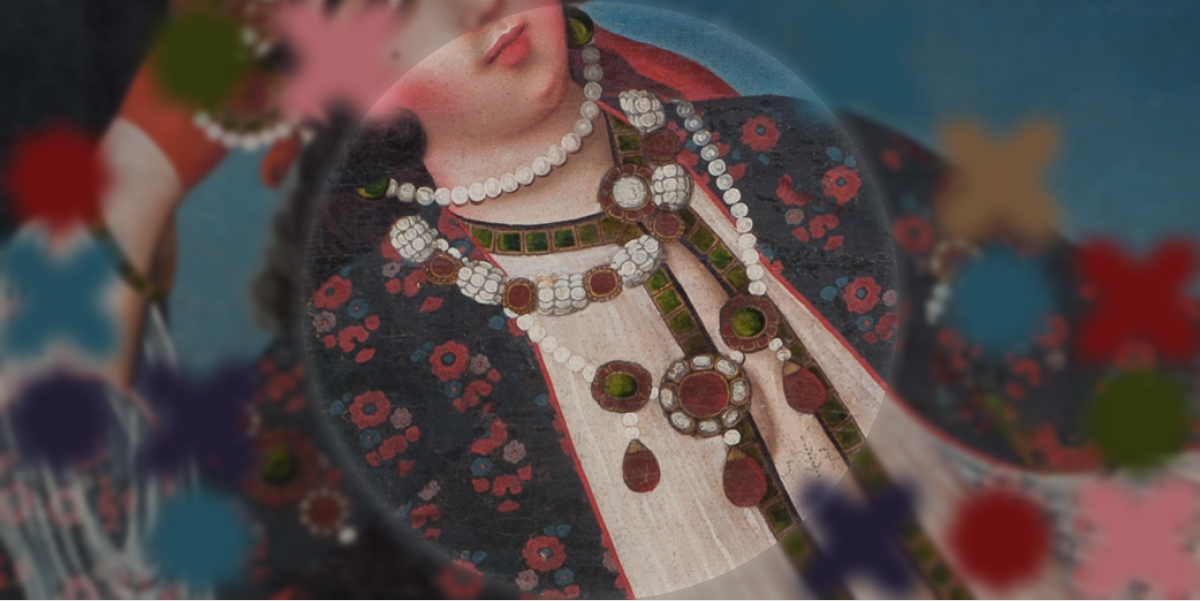
A string of beads nether the hat was an obligatory element in Iranian jewellery-making starting in the 15th century. A string of pearls was worn under the chin and attached to the lid or to pendants. In addition to pearls, the beauty in this portrait is also wearing emeralds, spinel (a red colored jewel), and rubies.
Shirts
A sheer undershirt with a slit upward until the omphalos was called a pirohan. An outer blouse was known every bit a nimtene. Both men and women liked to let the cuffs of their undershirts evidence: they were folded to show the inner side, especially if information technology was embroidered. Travellers from the beginning of the 19th century wrote that Iranian women were dissimilar those belonging to other nations in the region who would try to hide equally much of their trunk as they can in baggy clothes. Quite the contrary, in Islamic republic of iran, women wore clothes fitted tightly to their figure. However, in this instance the travellers were referring to what the women wore in the harem to expect bonny. They commonly didn't become exterior just if they did, they wore veils like other muslim women.
Scarf sash
This kind of scarf is some other fashion accessory that was to men and women. During Qajar rule, these items were produced locally following the model of cashmere scarves from India; this production was a source of considerable pride. The fabrics were made from goat wool. They were sometimes painted and wearing apparel were made from them, including nimtene blouses. At some point, productions began to close because of competition with imported goods. The Shahs tried to salve them past demanding that courtiers buy and make clothes from Iranian fabrics simply.
Jewellery
The jewellery of the harem women was made from precious and semi-precious stones which at that moment were kept in the Shah treasury. Pearls were very well-loved: large quantities of pearls were gathered from the Persian gulf and used with abandon: Fat'h-Ali Shah had xvi kilograms of pearls hanging in strings and clusters around his throne. Approximately 2-thirds of Shahs' treasure was composed of Indian precious stones that Nader Shah captured from the Mughals during his Indian entrada of 1739. He took with him the unabridged Mughal treasury by merely splitting the items stored in it into parts: stones separately, gold molten together. These items are still stored in the treasury of the Islamic republic of iran Central Bank—some of it as jewellery, and some just as heaps of stones and gold. Neither the Qajars nor the Pahlavis had managed to turn all of those resource into jewellery—in that location were just also many raw materials.
Forearm bracelets (bazubands) were also part of the obligatory set up of adornments for both sexes. For men, they covered one-half the forearm, while the women'southward versions were a fleck smaller and finer. One of the near characteristic Qajar jewellery items were earrings with enamel that were shaped like domed bells. These could be worn in rows of one, two, or three.
Lifestyle: Amusement and Decor

Alcohol
The decanter and the glass in the beauty'southward hands can be explained in various ways. Kickoff of all, alcohol acts as an illustration within the poetic associative chain: woman, intoxication, love. Such a comparing was not unique for the civilization of Qajar Iran—it came from 16th and 17th century Safavid Iran, and examples of its artistic depiction tin can be found in many objects. Qajars were an external dynasty, unrelated to the Safavids and without historical ties to Islamic republic of iran. Trying to position themselves as an ancient bloodline, they constantly tried to peek into the past and infringe historical aesthetics. Second of all, the delineation of a pitcher and glass are related to the setup of a traditional house. Information technology was divided into biruni, the official "male" zone, and a "female person" zone—andaruni, where people close to the house would gather. The paintings of beautiful women usually decorated the "male" function of the house and served to pleasure the guests. If someone could not afford female dancers or musicians, such paintings were a mode of creating a cute space. Alcohol was too an attribute of the "male" world: despite the Islamic prohibitions, Persians still drank it but did so in secret.
Hookah
The hookah was smoked equally frequently by men and women. Due to its popularity, there were even attempts to pass legislation limiting smoking among the Shah'southward entourage—people could spend one-half a day or even a whole 24-hour interval smoking the hookah, which would make court management and court work suffer. In the homes of people with at least moderate means, special servants took care of the hookah and the process of smoking: they lit it up, got it going, done, cleaned, and polished it. I's hookah was something akin to a favorite purse. 1 could have it forth when visiting, only this did not use to the women of the harem, who did not leave the palace.

Entertainment
Depicted beauties could be portrayed as performing acrobatics and circus tricks—doing handstands, tumblesets, or juggling. In reality, these exercises were not as wild as we might imagine: dancing in Qajar was a very peculiar activity. European travellers who described them said that the women simply twirled. Such numbers were performed not past the Shah's wives, but past concubines, most likely slaves. Everything that was related to music, dancing, and alcohol-drinking was always performed by the women who occupied the lowest ranks in the harem hierarchy. At the harem, theaters were as well organized where the women would produce plays for themselves. Just one of the most important ways of entertainment for women—both those living at the harem, also as all others—was the bathroom.

Cloth patterns
Patterns on the material refer to the Garden of Eden and classic images of Persian poetry. One example is the gul-u-bulbul (gul means "bloom" or "rose" and "bulbul" can be translated equally "nightingale"). In this well-known theme, a nightingale falls in honey with a rose and sings to it, while the big-headed rose is unmoved by the bird's dotty song, taking it for granted. This is a story near beloved, passion, God, Paradise—everything in the world.
Furniture
Cylindrical cushions were called mutaqqa. They were one of the few items of piece of furniture, replacing the dorsum of a sofa and all other elements of article of furniture. Sitting on the floor, carpets, and mattresses was traditional. During the twenty-four hours, these were rolled up or folded and put away, while in the evening they would be unfolded and rolled out again. In the second half of the 19th century, European furniture appeared equally a tribute to fashion. In photographs we oft can see people sitting on the carpet and eating on the floor, with chairs and tables continuing behind them.
Relationships
The harem was virtually a land unto itself: the wives of the Shahs, his children, and the children of his children all lived hither, every bit well as concubines, slaves, people serving the harem, and eunuchs. Girls lived at the harem until they got married, while boys were taken abroad at the age of vi or seven in lodge to become them used to conducting land affairs . All children built-in in the harem could take a place at court and attain a certain social status—even those who were born to concubines. The latter could not be heirs to the throne, just could concur positions in the army and diplomatic missions if the Shah was well-tending towards them. Harems also housed boys who worked as dancers and prostitutes. Sometimes they were dressed in women's apparel, which possibly also left its mark on Qajar conceptions of style and beauty.
Design past Yulia Semenova
More information about the exhibition can found hither
Source: https://easteast.world/en/posts/414

Post a Comment for "Persian Painting Woman Woman Scarf Tied Under Chin Art"